
An ADR licence is the everyday name for the ADR Driver Training Certificate, the photo card a driver needs to carry dangerous goods by road above the legal thresholds. You get it by passing a core module plus the modules for the classes you will carry, with every exam sat in person at an approved centre. The card lasts five years, and Driver CPC periodic training hours can be added to your course as an optional extra when you book.
Most drivers call it an ADR licence. On paper it is a certificate, and in your wallet it is a card. Whatever you call it, it decides which dangerous goods you are allowed to carry, and getting the details wrong can mean turning down work or driving a load you are not qualified for. This guide covers what the qualification is, who needs it, how the nine classes work, what it costs and how to keep it valid. If you already know you need it, our ADR training courses in Wigan list the next dates.
In this article
- What is an ADR licence?
- Who needs an ADR licence?
- What are the nine ADR classes?
- How is ADR training put together?
- How much does an ADR licence cost?
- How long does an ADR licence last?
- What happens in the ADR exam?
- Can you do ADR training online?
- Does ADR count towards your Driver CPC?
- ADR licence FAQs
What is an ADR licence?
ADR stands for the European Agreement concerning the International Carriage of Dangerous Goods by Road. The letters come from the agreement's French title, which is why they do not match the English words. It is an international agreement run through the United Nations Economic Commission for Europe, and in Great Britain it has legal force through the Carriage of Dangerous Goods and Use of Transportable Pressure Equipment Regulations 2009. The rules are revised every two years, so something that was true on your last course may have changed by your next one.
There is no ADR entry on your driving licence. When people say "ADR licence", they mean the ADR Driver Training Certificate, which is issued as a photo card. The back of the card shows the classes you are qualified to carry, the expiry date is printed on it, and you must have it with you to drive any dangerous goods. You cannot drive a dangerous goods load while you wait for the card to arrive.
| What people say | What it actually means |
|---|---|
| ADR licence | The everyday name for the qualification |
| ADR certificate | The ADR Driver Training Certificate, its formal name |
| ADR card | The photo card the certificate is issued as, showing your classes and expiry date |
Who needs an ADR licence?
You need one if you drive a vehicle carrying dangerous goods above the thresholds set in ADR. That covers fuel and chemical tanker drivers, gas delivery, hazardous waste collection, explosives haulage and general hauliers whose loads go over the limit. The rule follows the load rather than the size of the vehicle, so van drivers can need one as well as HGV drivers.
If carrying dangerous goods in an HGV is the main part of your job, you also need to be a qualified HGV driver with a Driver CPC. There is no minimum time you must have held your HGV licence before you start ADR training, and a criminal record does not stop you qualifying, although your employer may limit what you are allowed to carry. Drivers who collect from fuel terminals also need a Petroleum Driver Passport on top of ADR.
When you might not need the full qualification
ADR has a small load exemption at section 1.1.3.6, often called the 1,000 points rule. Every substance is given a transport category, and each category has a maximum quantity per vehicle:
| Transport category | Maximum per vehicle (kg or litres) | Multiplier for mixed loads |
|---|---|---|
| 0 | No exemption | Not applicable |
| 1 | 20 | 50 |
| 2 | 333 | 3 |
| 3 | 1,000 | 1 |
| 4 | Unlimited | Not applicable |
For a mixed load, multiply the quantity of each item by its multiplier and add the results together. If the total is 1,000 or less, the driver does not need the full ADR qualification. In Great Britain a few category 1 substances, including some blasting explosives, anhydrous ammonia and chlorine, have a higher limit of 50 with a multiplier of 20, so check the UN number as well as the category. HSE gives LPG as an example: it sits in transport category 2, so the limit is 333 kg.
The exemption does not cover tankers or bulk loads, and it does not remove every duty. The driver still needs general dangerous goods training with a record kept, the vehicle still needs a 2 kg dry powder fire extinguisher or equivalent, and the goods still have to be stowed properly. The calculation should be done by whoever plans the load, ideally a transport manager or Dangerous Goods Safety Adviser, not worked out at the depot gate.
Warehouse staff and managers
People who load, pack or sign off dangerous goods do not need the driver card, but they do need training for their part in the job. We cover this with a Dangerous Goods Awareness module, which issues a certificate.
What are the nine ADR classes?
Dangerous goods are split into nine classes by the type of hazard they create. Your card lists the classes you can carry, and the class decides which training module you take.
| Class | What it covers | Everyday examples | How it is trained |
|---|---|---|---|
| 1 | Explosives | Fireworks, ammunition, blasting explosives | Its own module, 6 hours minimum |
| 2 | Gases | LPG, oxygen, acetylene, aerosols | Class module or Group A |
| 3 | Flammable liquids | Petrol, diesel, heating oil, solvents, many paints | Class module or Group A |
| 4 | Flammable solids, and substances that ignite in air or give off flammable gas in water | Matches, metal powders, calcium carbide | Class module or Group B |
| 5 | Oxidising substances and organic peroxides | Ammonium nitrate fertilisers, hydrogen peroxide | Class module or Group B |
| 6 | Toxic and infectious substances | Pesticides, cyanides, clinical waste | Class module or Group A |
| 7 | Radioactive material | Medical isotopes, industrial radiography sources | Its own module, 6 hours minimum |
| 8 | Corrosives | Sulphuric acid, sodium hydroxide, battery acid | Class module or Group A |
| 9 | Miscellaneous dangerous goods | Lithium batteries, dry ice, asbestos | Class module or Group B |
Class 3 is the one most drivers ask about, because it covers fuel. Petrol, diesel and heating oil sit here alongside solvents and many paints. To drive a fuel tanker you need Class 3 with the tanks module, plus a Petroleum Driver Passport to load at a terminal.
Class 1 and Class 7 are trained separately because the risks are specialised. If you qualify for either and later want other classes, you also need to pass the packages or tanks module as well as the new class modules.
How is ADR training put together?
Every route starts with the core module. On top of that you add packages, tanks or both, depending on how the goods travel, and then the classes you need. You can train for single classes, or take a group route that covers several classes with shared characteristics: Group A covers classes 2, 3, 6 and 8, and Group B covers classes 4, 5 and 9. GOV.UK sets a minimum training time for each module:
| Module | Minimum training time |
|---|---|
| Core (everyone takes this) | 9 hours |
| Packages | 1 hour 30 minutes |
| Tanks | 7 hours 30 minutes |
| Class 2 or Class 3 module | 1 hour 30 minutes each |
| Class 4, 5, 6, 8 or 9 module | 45 minutes each |
| Common characteristics (for the group routes) | 1 hour 30 minutes |
| Group A (classes 2, 3, 6, 8) | 3 hours 45 minutes |
| Group B (classes 4, 5, 9) | 1 hour 30 minutes |
| Class 1 explosives | 6 hours |
| Class 7 radioactive material | 6 hours |
These are legal minimums, not course lengths. A full course, exams included, can run for up to seven days depending on the modules you take. You can add classes to your card later by taking the extra modules and their exams, so you do not have to train for everything at once.
How much does an ADR licence cost?
At Submatter, ADR training starts from £420 per delegate plus VAT. The final price depends on the modules you take, so adding tanks, Class 1, Class 7 or both class groups will change it. Refresher training is a separate course covering the classes already on your card, so ask for the refresher price rather than assuming it matches the initial course. You can see current ADR course dates and prices on our booking calendar.
A few other costs are worth knowing about before you book:
| Cost | What to expect |
|---|---|
| Failed exam | You can resit that module's exam within 16 weeks without repeating the training. Ask your provider what a resit costs. |
| Lost, stolen or damaged card | £15 for a replacement, usually within 10 working days of paying |
| Change of name on the card | No fee |
| Change of nationality on the card | £15 |
If you need several drivers trained, call 07513 683932. We can arrange a dedicated course around your rota.
How long does an ADR licence last?
Five years, and the expiry date is printed on your card. You can start refresher training up to one year before the card expires. Pass within that year and your new five years run on from the old expiry date, so booking early costs you nothing. Start earlier than that and the new five years run from the day you pass.
Two deadlines matter. The refresher exam must be taken at least two weeks before your card expires, and if the card runs out you go back to the full initial course. Refresher training covers the classes already on your card, so it is also a good point to think about whether you want to add any.
What happens in the ADR exam?
The exams come at the end of the course, usually on the last day, and are always taken in person at the training centre. They are multiple choice and completed on a computer, with one exam for each module you trained for. Interpreters are not allowed. You get your result straight away.
If you fail a module, you can retake that exam within 16 weeks without repeating the training, and there is no limit on the number of attempts. Once you pass, your card is posted within five working days, either to you or to your training provider. The card scheme is run for the Department for Transport by Qualifications Scotland, which is who to email if your card has not arrived after a week. Older paperwork may still show SQA, the body it replaced.
Can you do ADR training online?
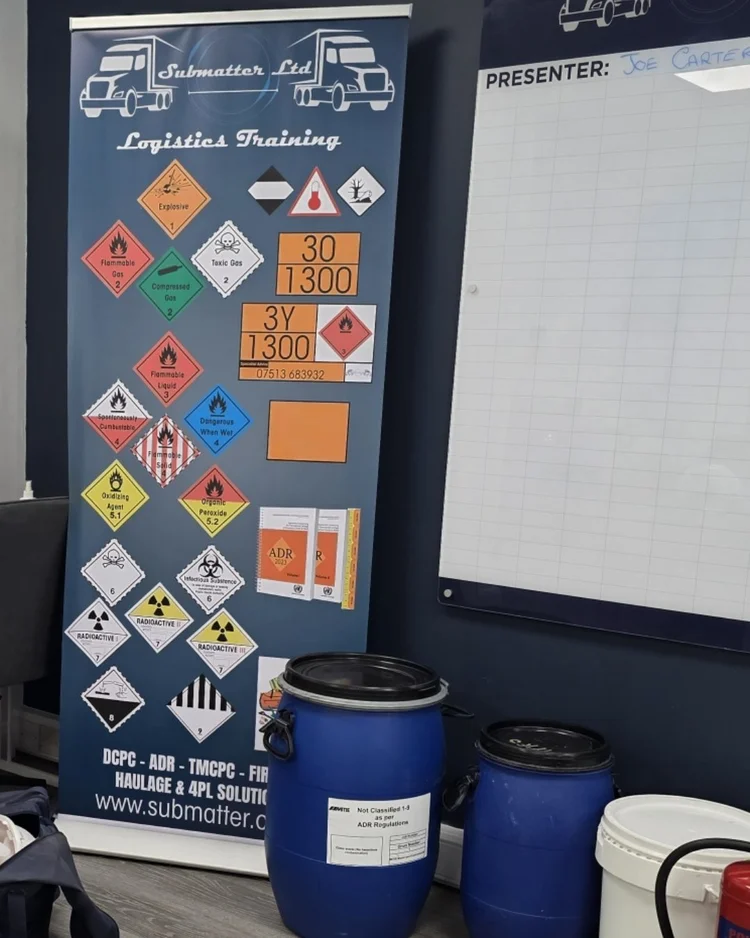
Not fully, and never the exam. ADR exams are always taken in person at an approved training centre and must be invigilated.
For 2026 only, a Department for Transport authorisation lets approved providers deliver the theory part of ADR training remotely, as long as the practical exercises are done in person. That authorisation ends on 31 December 2026. The Department has said there will be no further authorisations, because the UK will align with ADR 2027, the next edition of the agreement, from 1 January 2027. We will update this guide once the rules for UK courses from 2027 are confirmed.
Submatter runs all of its ADR training face to face in our Wigan classroom. Be wary of any course sold as fully online with no attendance at all, because it cannot lead to a valid ADR card.
Does ADR count towards your Driver CPC?
It can, as an optional extra. When you book an ADR course with Submatter you can add Driver CPC periodic training hours at £20 per seven hour day, up to 28 hours across the training days. Those hours count towards the 35 hours of periodic training you need every five years. Submatter arranges the certificates and registers the hours after the course, so there is nothing for you to claim yourself.
If you have already completed some periodic training modules, you may need fewer than the full 28 hours, so tell us when you book and we will add only what you need. For the rest of your hours, see our Driver CPC periodic training courses.
Ready to get your ADR licence?
Our training centre at 11 Beecham Court, Wigan, is just off junction 25 of the M6 and takes drivers from across Greater Manchester, Lancashire, Merseyside, Cheshire and Cumbria. Check ADR course dates and book online, call 07513 683932, or send us a message if you are not sure which classes you need and we will work it out with you. If you are still working towards your HGV licence, our HGV licence training covers Class 2 and Class 1, and ADR can follow once you are driving.
Find this guide useful? Add Submatter as a preferred source on Google so our guides are easier to find in your Top Stories and AI results.
ADR licence FAQs
Is an ADR licence the same as an ADR certificate?
Yes. "ADR licence" is the everyday name, the formal name is the ADR Driver Training Certificate, and it is issued as a photo card. It is separate from your driving licence and does not appear on it.
Can I get an ADR licence without an HGV licence?
ADR is a separate qualification from your driving licence, and the thresholds apply to vans as well as lorries. If carrying dangerous goods in an HGV is the main part of your job, you also need an HGV licence and a Driver CPC. There is no minimum time you must have held the HGV licence before you train for ADR.
What happens if my ADR card expires?
You cannot carry dangerous goods above the thresholds until you requalify, and you have to take the full initial course again rather than a refresher. To avoid that, take the refresher exam at least two weeks before the expiry date on your card.
Can I add more classes to my ADR card later?
Yes. You can add classes at any time by taking the extra modules and passing their exams. If your card only covers Class 1 or Class 7, you also need the packages or tanks module before other classes can be added.
What happens if I fail one of the ADR exams?
You only resit the module you failed, and you can do it within 16 weeks without repeating the training. There is no limit on attempts. Ask your training provider whether a same day resit is possible and what it costs.
How long does it take to get my ADR card?
The card is posted within five working days of passing, to your address or your training provider's. You must not carry dangerous goods until you have it. If it has not arrived after a week, email Qualifications Scotland at adr@qualifications.gov.scot.
Do I need ADR to drive a fuel tanker?
Yes. Fuel is Class 3, so you need the core module, the tanks module and the Class 3 module, or the Group A route, which includes Class 3. To load at a fuel terminal you also need a Petroleum Driver Passport.
